
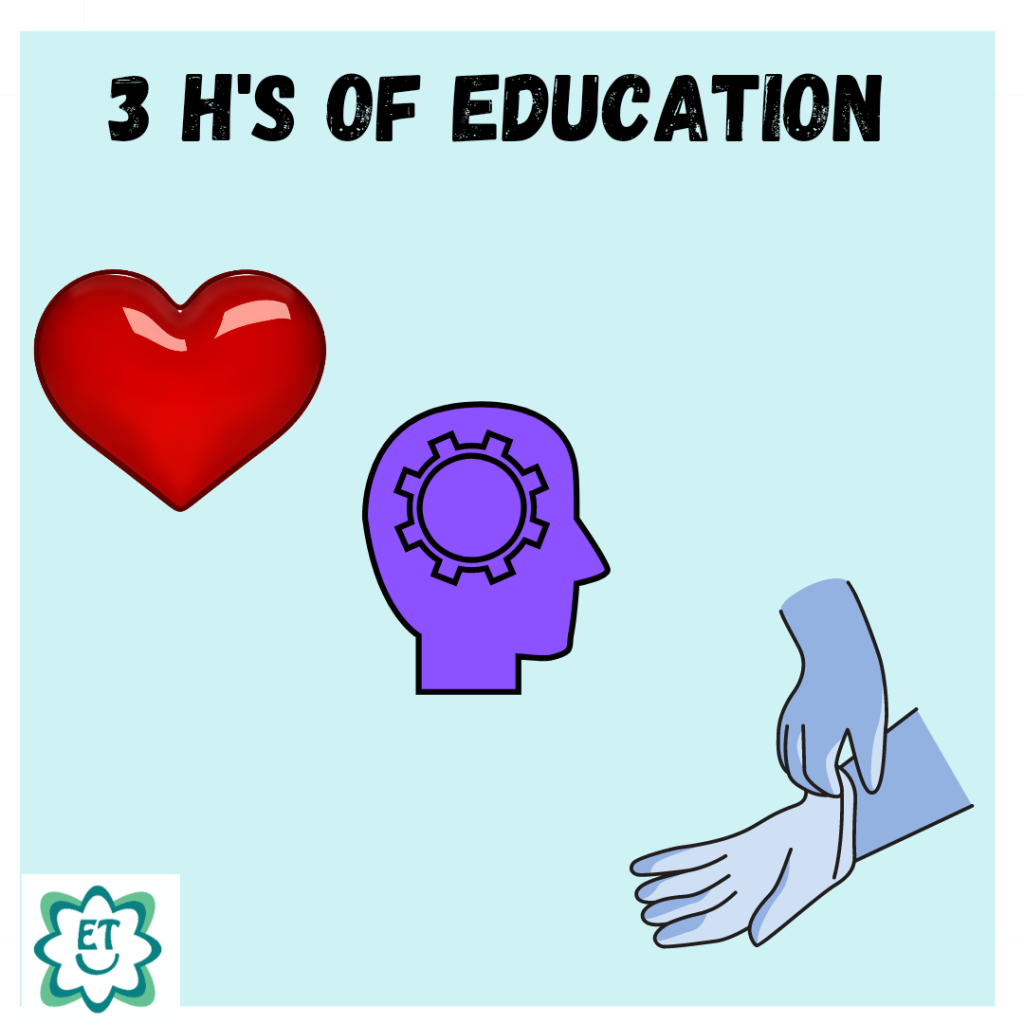
The 3 H’s of education: the heart, head and hands are in my opinion stated here in order of importance. Technically these are equivalent to the affective, cognitive and psychomotor domains of learning as espoused by the Bloom’s taxonomy of learning objectives.
The education system has long focused on the cognitive (head knowledge) with rote learning and standardized exams being at the forefront. In a bid to improve all round education, since the beginning of the 21st century, the psychomotor has been brought to the fore with increased awareness of things like kinaesthetic learning styles, project based learning and activity based learning. This is also shown in common use of maxims like ‘tell me and I forget, show me and I remember and involve me and I understand’ or ‘What I hear I forget, what I see I remember and what I do I understand.” It can’t be denied that this new trend has brought tremendous improvement to education especially from the perspective of the learners; who are more engaged and can better apply the concepts taught at school.
As a society, that is fast becoming a global village, one of the few things lacking is social stability. There is an increase in bullying, violence and conflict on all fronts. The home as the moral fibre for the society is no longer what it used to be. The onus is on the schools to touch the hearts of the learners, to ‘produce’ balanced individuals that make up the social fabric of the stable society: a world built on communication, collaboration and compassion.
Maya Angelou famously said, “People will not remember what you said but how you made them feel.”
The Affective Domain.
I’m not sure how it’s done in other places but my experience with Nigerian schools shows that the only time we think actively about the affective skills of our learners is when we fill in the affective section of report sheets. Many teachers spare some seconds of thought before they tick 3 or 4 out of five for a learner, but some seem to mark arbitrary patterns as I have had cause to look at some report sheets marked 3 on punctuality for a child who is never late.
It is critical we remember the true essence of this domain, that we ensure we factor values and motivation while planning our lessons and class activities. We need to include relevant objectives, monitor engagement and attitude and adjust the lesson as the situation warrants.
Rasheedat Sadiq
The Emolligent Teacher 🙂